A major international collaboration of 356 scientists, including Professor Ferry Slik (FOS, UBD) has found almost identical patterns of tree diversity across the world’s tropical forests.
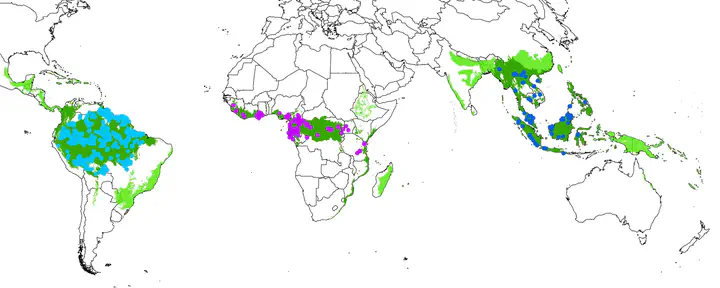
The study of over one million trees across 1,568 locations, published in Nature, found that just 2.2% of tree species make up 50% of the total number of trees in tropical forests across Africa, the Amazon, and Southeast Asia. Each continent consists of the same proportion of a few common species and many rare species.
While tropical forests are famous for their diversity, this is the first time that scientists have studied the commonest trees in the world’s tropical forests.
The scientists estimate that just 1,053 species account for half of the planet’s 800 billion tropical forest trees. The other half are comprised of 46,000 tree species. The number of rare species is extreme, with the rarest 39,500 species accounting for just 10% of trees.
The findings have profound implications for understanding tropical forests. If we focus on understanding the commonest tree species, we can probably predict how the whole forest will respond to today’s rapid environmental changes. This is especially important because tropical forests contain a tremendous amount of stored carbon, and are a globally important carbon sink.
Identifying the prevalence of the most common species gives scientists a new way of looking at tropical forests. Tracking these common species may provide a new way to characterise these forests and, in the future, possibly gauge a forest’s health more easily.
The researchers found strikingly similar patterns in the proportion of tree species that are common, at about 2.2%, despite the tropical forests of the Amazon, Africa and Southeast Asia each having a unique history and differing contemporary environments.
The Amazon consists of a large region of connected forest, while Southeast Asia is a region of mostly disconnected islands. People only arrived in the Amazon around 20,000 years ago, but people have been living in African and Southeast Asian forests for more than twice that length of time. In terms of the contemporary environment, African forests experience a drier and cooler climate than the other two tropical forest regions.
Given these striking differences, the near-identical patterns of tree diversity suggests that a fundamental mechanism may govern the assembly of tree communities across all the world’s tropical forests. The researchers are not yet able to say what that mechanism might be, and it will focus future work on identifying it.
See table below for a list of the most common tropical tree species.
The researchers assembled forest inventory data from intact tropical forests. In each of 1,568 locations, teams identified and recorded every tree with a trunk greater than 10 centimetres in diameter, in a patch of forest, usually one hectare, which is a square of forest measuring 100 metres on each side.
Professor Slik together with several other authors has been collecting and collating this data for 20 years. The effort is a collaboration of the largest plot networks across the Amazon (Amazon Tree Diversity Network; RAINFOR), Africa (African Tropical Rainforest Observatory Network, AfriTRON; Central African Plot Network), and Southeast Asia (Slik Diversity Network; T-FORCES), brought together for the first time for the published analysis.
This collaboration across hundreds of researchers, field assistants, and local communities resulted in a total of 1,003,805 trees sampled, which included 8,493 tree species, across 2,048 hectares, equivalent to almost eight square miles of forest. The teams inventoried 1,097 plots in the Amazon totalling 1,434 hectares, 368 plots in Africa totalling 450 hectares, and 103 plots in Southeast Asia totalling 164 hectares.
Most common tropical forest tree species:
| Continent | Scientific name | Local Names |
|---|---|---|
| Africa | Gilbertiodendron dewevrei | Limbali, otabo, agbabu, ekpagoi-eze |
| Africa | Greenwayodendron suaveolens | Africa Teak, atorewa, ẹ́wáé, nchua, eleku, agudugbu |
| Africa | Anonidium mannii | Junglesop, imido, asumpa, ọ̀ghẹ́dẹ́gbó |
| Africa | Petersianthus macrocarpus | Stinkwood tree; soap tree abalé, tun-tue, pèh, ésiv, kpa |
| Africa | Santiria trimera | adjouaba à racines aériennes, damzin, an-thanjka, kafe, poh, gólógóló. |
| Africa | Strombosia pustulata | itako, afina, poé, mba esogo |
| Africa | Tabernaemontana crassa | Adam’s-apple flower, k-poŋgbo, opuko, patié patié, pete-pete |
| Africa | Staudtia kamerunensis | Niové, ichala, ọbara-okisi, íyìp ókōyò |
| Africa | Strombosiopsis tetrandra | Bwika, Mbazoo |
| Africa | Dichostemma glaucescens | Mangamba, Mongamba |
| Amazonia | Oenocarpus bacaba | Bacaba, Turu Palm |
| Amazonia | Eschweilera coriacea | matamatá |
| Amazonia | Iriartea deltoidea | bombona |
| Amazonia | Pentaclethra macroloba | pracaxi |
| Amazonia | Euterpe oleracea | açaí palm |
| Amazonia | Astrocaryum murumuru | murumuru |
| Amazonia | Geissospermum sericeum | quina-quina branca, pao pereira |
| Amazonia | Eperua falcata | bootlace tree, bi udu, wapa |
| Amazonia | Euterpe precatoria | mountain cabbage; açai, açaizeiro, açaí-do-amazonas, palmiche, wassaï, huasaí, manaca |
| Amazonia | Rinorea racemosa | branquinha |
| Southeast Asia | Shorea multiflora | yellow meranti |
| Southeast Asia | Tristaniopsis merguensis | Hill Tristania |
| Southeast Asia | Cotylelobium melanoxylon | Resak hitam; Khiam khaao; Resak tempurong; Giam tembaga |
| Southeast Asia | Dehaasia caesia | Magasil, Medang |
| Southeast Asia | Streblus ilicifolius | Jungle Holly, Merlimau |
| Southeast Asia | Shorea xanthophylla | seraya kuning barun |
| Southeast Asia | Shorea parvifolia | light red meranti, white lauan |
| Southeast Asia | Elateriospermum tapos | Perah, Buah Perah, Pogoh Nut, Tapos |
| Southeast Asia | Ixonanthes reticulata | Pagar Anak, Ten Men Tree, Inggir Burong, Nyiran Burong |
| Southeast Asia | Gluta oba | Rengas |
Cooper, D.L.M., Lewis, S.L., Sullivan, M.J.P. et al. Consistent patterns of common species across tropical tree communities. Nature (2024). https://doi.org/10.1038/s41586-023-06820-z